The Daily Mail in 1896 became the first newspaper to combine the photographic image with that of the written language. The then innovative mixture of words and pictures, has over subsequent generations, become a familiar part of our cultural landscape.
I can't be without either.
There is an on-going debate about words and whether they actually exist.
The argument is that the human brain sees them as a series of letter images. Over time we develop a library of rounded corners, horizontal and vertical lines and then mentally, match the features of what we are currently reading with those we have collected from the past.
The sequence gives us the word.
Letter image or word, what amazes me is how much original material has survived from so long ago. Documents
of considerable cultural, historical and political importance, such as
the Magna Carta, the Book of Kells, the Declaration of Independence
remain intact, and are priceless. Whilst letters and diaries by key figures as well as ordinary people speak volumes about the issues and social conditions of the day.
Technological innovation has played an important part in preserving the richness and diversity of our heritage. Without it much would have been lost. Shakespeare has much to thank Gutenberg for. Hardly any of his hand-written documents survive. Gutenberg's press undoubtedly contributed to Shakespeare's global standing as a literary superstar.
It is complex. Ken Burns triumph is that his careful use of words and images have made it immediately understandable and powerfully unforgettable.
Tales from Cravant

A Cravant View
Friday, January 4, 2019


Wednesday, January 2, 2019
Seeing in the new year!

First up, Tales from Cravant. Until a few years ago my blog appeared regularly, often daily, sometimes weekly, with shorter reads and longer reads. Then I stopped. Things happen. But the arrival of 2019 has brought with it the realisation that I've missed the process. So I'm resurrecting my blog.
Writing was for a long time part of my working life, speeches, copy for newspapers, magazines, brochures etc. I also enjoyed writing letters, long-hand only, never typed, sometimes with a fountain pen, sometimes a biro. Luckily I had a couple of pen pals who shared the same enthusiasm. The first, Aunt Dolly, lived in San Diego, the other, Helen, lived in Tel Aviv, although she spent a fair bit of time away in Europe. She and I met by chance whilst travelling in Canada and America.
On average we wrote four times a year on single sheet airmail paper. Not for the faint-hearted, because each fattish envelope that arrived in our respective mail boxes, contained 15 or 16 pages. I don't know how the others approached writing their letters or where they liked to write. Mine were always written at home, seated at the dining room table, which had good light coming in from the side. Each took a whole day to complete with time allowed, in between, for the mundane essentials. If the writing took time, so did the reading.
The act of placing a pen on paper is a huge commitment. There isn't the same pressure perhaps as writing commercially or completing an exam paper where the collection of words has the capacity to change your future, realising some dreams, undermining others, if thoughts aren't succinct enough or original enough. Writing a letter nonetheless carries a heavy responsibility of being entertaining as well as interesting. Blogs in this respect are the same.
Aunt Dolly and I were pen pals for at least twenty years. Eventually the arthritus in her hands made anything more than a single-sided letter, impossible, and that was painful enough. I kept writing as always, until finally she wasn't there to write to any longer. Helen and I kept writing to each other for nearly ten years after we met. I learnt much from her. Helen's last letter was long. 1995. She had been to the Rabin rally in Tel Aviv and was standing at the front embracing a young Arab man. Both had been inspired to believe that peace was possible. Minutes later, Rabin was murdered in front of them, by another Israeli, Yigal Amir. Helen walked back to her apartment and started a letter. This wanton act of destruction that she had witnessed, kept Helen writing through the night. I still have it. Twenty pages long.
I treasure it.
Sunday, June 7, 2015
Giverny 1 - The little green bridge

Giverny is a very popular place. In fact the whole village is Monet-esque. It is very pretty and clearly well maintained. I'm assuming that strict regulations apply.
We arrived in Tuesday afternoon, made a sortie round the village to check where everything was and then arranged with Sandrine to go to the gardens first thing the next morning. Because of my photography she was able to organise a special pass so that I could go back after closing on Wednesday evening. If you are classified as an artist it is possible to go. But she had to book it for me and did. The rules meant that Mike couldn't come.


By 11am the gardens were heaving. Our timing was good to get into Monet's house. It's a delight. We were early in the queue, so went in quickly and then left soon after, as it was the last thing for us to see.
Giverny with its history, particularly that of the gardens, is a place that inspires. So it's no surprise to discover that there are over 500,000 visitors each year. The range of nationalities and languages on the day we went was really quite something. On the other hand those numbers, given the size of the gardens at Giverny, are problematic.

Thanks to Sandrine, that connection came Wednesday evening. I went back into the gardens with my permit soon after the doors had closed, and found myself in there with just seven other people, as opposed to seven thousand.
I can only describe the experience as emotional. It was also a real privilege. The contrast was extreme with that of the morning. I headed immediately to the little green bridge and the lilypads. At that point no one else was there. To walk in complete tranquility around the lake, to stand in perfect and peaceful solitude on the green bridge, to look across and around with only natural sounds for companionship was quite simply, breathtaking. At one point I was shaking so much I could barely hold the camera steady and had to sit briefly to get my head in gear. The photos here are all from this second visit. The early evening light and the reflections were idyllic. It is undoubtedly my favourite time of the day. Such a moment.
I only wish Mike could have been there.
Wednesday, May 13, 2015
About David
 |
| David |
The blog this time marks the passing of David Shearing after a long battle with cancer.
David had a motto - "I shall pass through this world but once. Any good thing that I can do or kindness I can show any human being, let me do it now and not defer it, for I shall not pass this way again."
David and Taffy lived this credo to the limit. They were passionate and committed to each other, to their shared interests, but also to doing what was right. In a country like South Africa, during the apartheid days, this took considerable determination and courage.
I first met David and Taffy when they had their sheep farm Layton, which was in the karoo - an extraordinary landscape, tough semi-desert, vast, challenging, sometimes dangerous, endlessly fascinating, always majestic. It is South Africa's biggest eco-system. I fell in love with the place and the cousins, and even though the family moved away some time ago, when Mike and I go back to South Africa, we always make a pilgrimage to the karoo.
Dinner, that first night of that first visit to Layton was a different affair for this London girl.
David had been having problems with a porcupine. Although endearingly like an oversized hedgehog, said porcupine had been raiding David's vegetable patch and causing a certain amount of damage. David had had enough. The trial of wits took place in the early hours one morning a few days before, and the outcome arrived on a carving plate, fortunately without the quills. A delicious roast, served with squash.

The karoo landscape wasn't the only trail of discovery to be mined. Family history proved irresistible. Taffy with her Welsh ancestry, David with his Anglo/Scottish ancestry, have led to an impressive family tree that spreads across many centuries and countries. I first saw the South African Shearing's family bible, back in the 80s. An enormous tome, that David's mother, Aunt Marge was attempting to update in her beautiful fountain-penned handwriting. Now of course through David and Taffy's perseverance the family tree is online.
However it is probably their combined work on the South African war in the Cape Colony, that represents David and Taffy's greatest achievement. It is a true legacy and testament to their tenacity. They produced a series of books - the Cape Commando Series. Taffy did the writing and David the editing and marketing. The research was a real labour of love, stretching over many years. Ultimately together, they produced a new book entitled The Rebel Record the database for which had previously been used by Taffy in support of her dissertation for her doctorate -
The Cape Rebel of the South African War 1899-1902 - which she submitted and was awarded in 2004.
In the Dedication for her doctorate Taffy wrote:
"This thesis is dedicated to my husband, David, my true friend and life's companion.
I am the most privileged of people to have written a thesis in an atmosphere of genuine encouragement and steadfast support. For this, my love, I am deeply grateful."
To Taffy, Eleanor, Michelle and all the family, this blog is dedicated to a wonderful human being whom we are privileged to have known. For this we are deeply grateful.
Hilary and Mike
Sunday, April 12, 2015
Domaine Noiré - C'est top!
We've often said how spoilt we are for good food and good wine in this part of France, and mentioned the conviviality that pervades daily life. Sometimes all three elements come together in one place. This is the experience at Domaine de Noiré, conveniently situated on our way in to Chinon.
Our first encounter with Domaine de Noiré and the owners Jean-Max and Odile Manceau, was at the Chinon Wine Fair (April) about five years ago. Since we moved here in 2013, we've got to know them quite well. It was their wines we took over to the UK as Christmas presents last year for family and friends. We went with neighbours to their first season of summer jazz, also in 2014, and we've shared a few evenings together. They are charming people.
Jean-Max was until 2014, President du syndicat des vins de Chinon, a position he held for seventeen years and from 2010 until this year, President de la Fédération des Associations Viticoles d'Indre et Loire et de la Sarthe. He and Odile represent the best of their profession.They are lovers of the land and the grape, working in harmony with their environment to produce the most beautifully structured, smooth and balanced reds, whites, rosé and pétillant.
The reputation of the Chinon appellation is firmly centre on its relationship with food.
At Domaine de Noiré, the team has recognised the need for visitors to better understand the pairing of wine with food as well as the process of wine production. So they have developed a Wine Tourism programme, which offers various packages whereby visitors can discover the pleasure of Domaine de Noiré wines, local cuisine and other cultural delights.
We were very priviledged to be invited to the launch of the Wine Tourism programme last Thursday. The others guests were journalists, professional marketeers, wine experts and tourism specialists. We were there for various reasons, one of which was my involvement with the voluntary Greeters programme at the Tourism Office in Chinon.
It was a morning affair which began around 9am at Domaine de Noiré, with coffee and viennoiserie. Jean-Max and Odile were perfect hosts. We each introduced ourselves to the rest of the group and chatted happily together before beginning our discovery of the Domaine's and Chinon's heritage. We had been told to wear something warm.
We left by horse-drawn carriage/une calèche, a 22-seater pulled by Tino and Titeuf and made our way, so comfortably to the pier on the Vienne in the centre of Chinon. It's a great way to travel and the day was absolutely perfect for it. The calèche and horses belong to Domaine de Noiré and are used for various official functions at other times of the year.
At the pier we made our way on to a local barge (une gabare) operated by the Vienne Loire Navigation Company, who in fact we have travelled with before, but that time in an open boat, whereas this time there was a large open-sided cabin towards the back, which could be closed up if the weather was bad.
Once everyone was on board, we set off for a river trip, which took us on a round-trip to experience both sides of the Vienne. From the river La Forteresse at Chinon looks particularly stunning - a real Lion in Winter moment. Terrific ride, incredibly comfortable and of course forewarned we were wearing the right gear, to counter the river breeze.
As we sailed gracefully along in what must have been near perfect conditions, we were treated to a gourmet picnic - wines from Domaine de Noiré (red and rosé) and mouthfuls of heaven prepared by the chef from Au Chapeau Rouge (Chinon) - Christophe Duguin, including terrine of foie gras, fish terrine with Touraine saffron, goat's cheese. We met him when we first arrived at Domaine de Noiré in the morning.
We returned to the pier, climbed back on to the calèche, and made our way to Domaine de Noiré, where were given a tour of the cave, with Jean-Max providing the history and explanation. There was an extra wine tasting treat of the two white wines produced at the Domaine. "Amphora" which is produced in an Italian Amphora (a huge terracotta pot-container), which brings a whole new meaning to hand-crafted wine. Our tasting was silky, delicate and just lovely. The other "Noiré Blanc" was fabulous, complex and just delicious. Both will be ready in a few months.
Our now "end of morning" rounded off with more wine tasting, more delights from Christophe Duguin, particularly the Nougat de Tours, which has a sweet pastry base, with candied fruit, apricots, with almond macaroon or macaronade on top. There is a wide variety of recipes but Christophe Duguin as with everything else has made this one his own. The original recipe goes back to the Middle Ages - the time of Leonardo da Vinci and a Touraine (includes our region - Indre et Loire) speciality.
The whole event was superbly managed and beautifully presented. A truly fabulous time, which launched Domaine de Noiré's new initiative and the new season in real style.
Chapeau et merci à tous !!
Our first encounter with Domaine de Noiré and the owners Jean-Max and Odile Manceau, was at the Chinon Wine Fair (April) about five years ago. Since we moved here in 2013, we've got to know them quite well. It was their wines we took over to the UK as Christmas presents last year for family and friends. We went with neighbours to their first season of summer jazz, also in 2014, and we've shared a few evenings together. They are charming people.
Jean-Max was until 2014, President du syndicat des vins de Chinon, a position he held for seventeen years and from 2010 until this year, President de la Fédération des Associations Viticoles d'Indre et Loire et de la Sarthe. He and Odile represent the best of their profession.They are lovers of the land and the grape, working in harmony with their environment to produce the most beautifully structured, smooth and balanced reds, whites, rosé and pétillant.
The reputation of the Chinon appellation is firmly centre on its relationship with food.
At Domaine de Noiré, the team has recognised the need for visitors to better understand the pairing of wine with food as well as the process of wine production. So they have developed a Wine Tourism programme, which offers various packages whereby visitors can discover the pleasure of Domaine de Noiré wines, local cuisine and other cultural delights.
 |
| Jean-Max studying the viennoiserie |
 |
| une calèche |
At the pier we made our way on to a local barge (une gabare) operated by the Vienne Loire Navigation Company, who in fact we have travelled with before, but that time in an open boat, whereas this time there was a large open-sided cabin towards the back, which could be closed up if the weather was bad.
 |
| La Forteresse - Chinon |
As we sailed gracefully along in what must have been near perfect conditions, we were treated to a gourmet picnic - wines from Domaine de Noiré (red and rosé) and mouthfuls of heaven prepared by the chef from Au Chapeau Rouge (Chinon) - Christophe Duguin, including terrine of foie gras, fish terrine with Touraine saffron, goat's cheese. We met him when we first arrived at Domaine de Noiré in the morning.
 |
| Tino and Titeuf |
Our now "end of morning" rounded off with more wine tasting, more delights from Christophe Duguin, particularly the Nougat de Tours, which has a sweet pastry base, with candied fruit, apricots, with almond macaroon or macaronade on top. There is a wide variety of recipes but Christophe Duguin as with everything else has made this one his own. The original recipe goes back to the Middle Ages - the time of Leonardo da Vinci and a Touraine (includes our region - Indre et Loire) speciality.
The whole event was superbly managed and beautifully presented. A truly fabulous time, which launched Domaine de Noiré's new initiative and the new season in real style.
Chapeau et merci à tous !!
Saturday, April 11, 2015
Lunch at the Boule de Fort
 |
| Bon Accord |
We've a lot of French friends who are always introducing us or involving us in hitherto unknown events and organisations. One of these is the Boule de Forte Club in Chinon - Cercle de Bon Accord, which our friends and long-time members Gilles et Marie-Lou invited us to visit for lunch, in November last year. The lunches take place once a month. Someone plans the menu - there's a rota, others look after the apéros, and there are plenty of hands to help serve the meal on the day. We've been to five lunches now, including our own this last week!
The Bon Accord is a great place, but well hidden. We've driven past it at least once a week probably, over the last seven years and not realised it was there. The building is set well back from the road and when the full-size wooden front gates are closed, it is invisible, even to someone walking by. So the fact that the club was there at all was the first surprise.
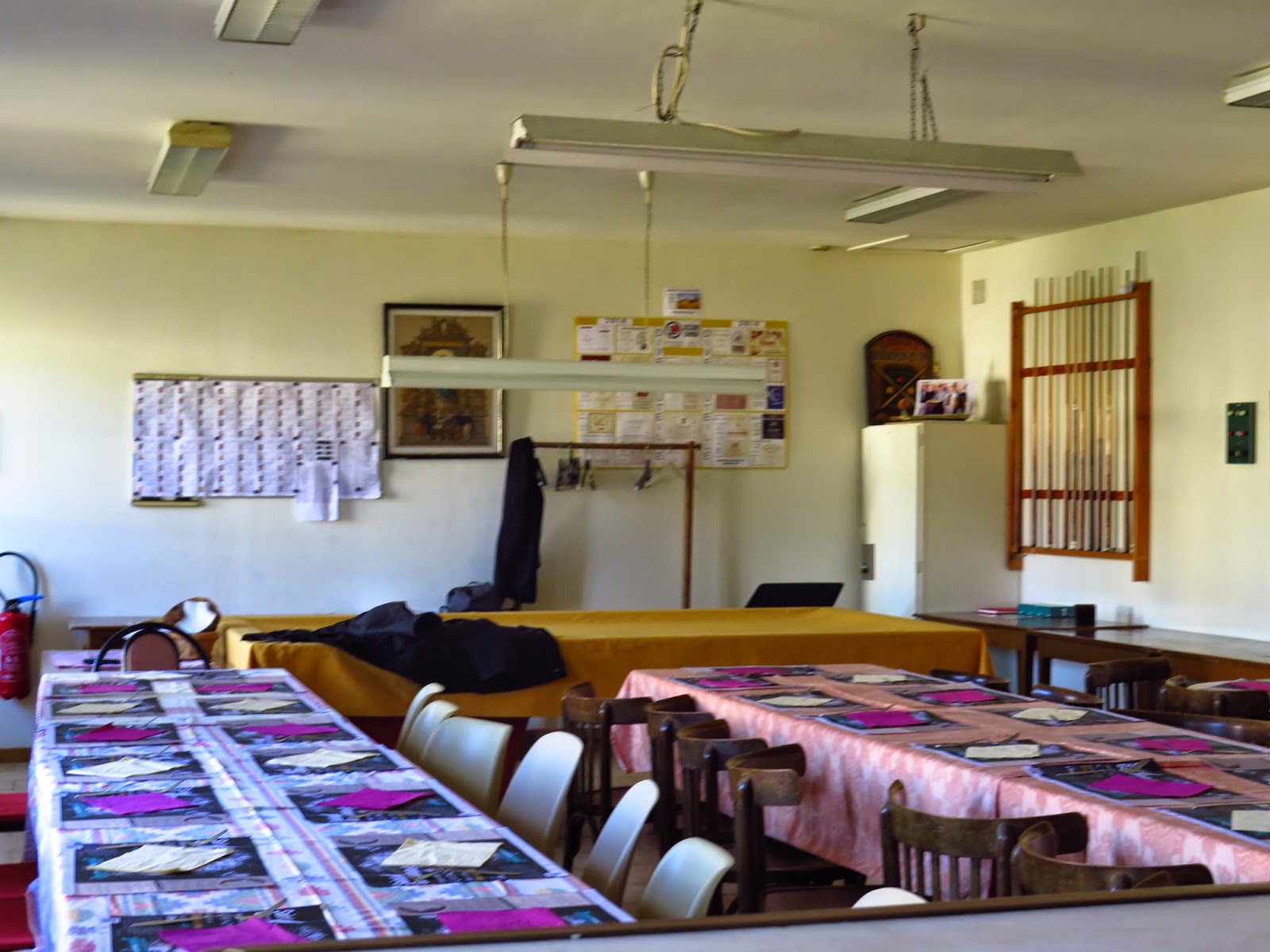
Inside there's the main room with a bar at the end. Usually the tables are together in small groups, but for a lunch the space is re-organised. If there's around 25 people, the tables are laid out width ways on. For our lunch, they were set up length ways from the far end to just in front of the bar. It's a good space and very practical.
The welcome we got the first time we went was just lovely. The members are great and very friendly. That's how it's been ever since. We took to it straight away and said we'd like to sign up. So from January this year we've been going once a month, for lunch with other members. We've have tried the game once and hopefully will be able to sort out a bit of tuition, so we understand the rules and technique a bit better. There are differences between boule and English bowls. It's difficult to see in the photo, but the rink is curved, which requires a different technique to play, more like placing the boule rather than launching it.
 |
| Ready to go |
What neither we or anyone else had remembered was that Easter was the weekend immediately before. Allowing for preparation time, meant that the shopping had to be done on the Saturday.
 |
| Marie-Christine |
Anyway come the day we got there for 10am and basically everything went like clockwork, except for the ovens, which cooked differently. Fortunately everything was fine. The singing went down well as did Mike's apéros. Everyone was very complimentary about the meal, which given all the clean plates was very satisfying. Huge relief truly. Most grateful to all our helpers at the club, particularly Marie-Christine, Janine, Gilles.
So we did ok - phew!!
Tuesday, April 7, 2015
All Quiet on the French Front . . .
Well not exactly, although it might seem like it, given that my last posting was back in February. In fact we've been flat out, working hard and having a great time. Started on the garden with the help of neighbours. It had got out of shape and there was some problematic planting. If we can keep going, just doing a bit at a time, we'll get it done. Going to be decorating shortly as well.
At the moment we're up to our necks with cooking. Doing a lunch tomorrow in Chinon.
We joined a club back in January which has its own Boule de Fort court. Once a month they have a lunch which is organised on a rota basis, but basically there is a handful of people who do the cooking and others who help. Anyway the friend who got us involved suggested we did an English lunch in April, usually for around 25 people, but for some reason this time there are 45 coming. It's been an interesting exercise. We've never cooked lunch for that number before. It's always a traditional four course menu, including cheese, and there's all the apéro stuff as well. So a lot of work. Right now we're both feeling a bit knackered. Oh and they've also asked us to do some singing beforehand!
No one at the time had realised this lunch was straight after Easter. Here everything was closed except for Saturday morning, so we braved Leclerc to get all the shopping done. Went early so it wasn't too bad. Some friends from the club came as well to help. There's an account with Leclerc so we didn't have pay for anything as it all got charged back to the club.
Anyway keep everything crossed that it goes well.
At the moment we're up to our necks with cooking. Doing a lunch tomorrow in Chinon.
We joined a club back in January which has its own Boule de Fort court. Once a month they have a lunch which is organised on a rota basis, but basically there is a handful of people who do the cooking and others who help. Anyway the friend who got us involved suggested we did an English lunch in April, usually for around 25 people, but for some reason this time there are 45 coming. It's been an interesting exercise. We've never cooked lunch for that number before. It's always a traditional four course menu, including cheese, and there's all the apéro stuff as well. So a lot of work. Right now we're both feeling a bit knackered. Oh and they've also asked us to do some singing beforehand!
No one at the time had realised this lunch was straight after Easter. Here everything was closed except for Saturday morning, so we braved Leclerc to get all the shopping done. Went early so it wasn't too bad. Some friends from the club came as well to help. There's an account with Leclerc so we didn't have pay for anything as it all got charged back to the club.
Anyway keep everything crossed that it goes well.
Sunday, February 22, 2015
Marketing Wine in France - The Big Question
If there was a choice of one item that immediately says France, at least in the minds of visitors, it would probably be wine. Holiday makers and day-trippers are usually on the look-out for a wine bargain. Back in the UK of course there will be a good range of French wines on supermarket shelves, in wine depots and special wine stores. These days with the internet, it's easy to find wine from anywhere in the world and order it online direct from the merchant. There are wine tasting clubs and restaurants who organise special dinners around a particular wine estate, for regular diners - at a price of course. Then there are all those wine offers in magazines and newspapers, on the tv and through internet advertising. Think of all those promos around holiday periods. And what about M&S and their special £10 dinner with wine offer that appears regularly on t.v. Advertising and the promotion of alcohol from wines and malts through sherry, beers, ciders and everything else in between, is a regular feature in British culture.
In 1991, the Evin Law was introduced in France with the aim of regulating alcohol (and tobacco) advertising. It can be summarised as follows:
• no advertising should be targeted at young people
• all drinks over 1.2 per cent alcohol by volume are considered as alcoholic beverages.
• no advertising is allowed on television or in cinemas
• no sponsorship of cultural or sport events is permitted
• advertising is permitted only in the press for adults, on billboards2, on radio channels (under precise conditions), at special events or places such as wine fairs, wine museums. When advertising is permitted, its content is controlled.
• messages and images should refer only to the qualities of the products such as degree, origin, composition, means of production, patterns of consumption
• a health message must be included on each advertisement to the effect that ”l’abus d’alcool est dangereux pour la santé“ : alcohol abuse is dangerous for health.
Whilst places and media where advertising is authorised, are defined, the internet is not mentioned explicitly as permissible media. It was not fully developed in 1991 when the law was passed. Although modified in 2005, the internet was still not mentioned in the revised law. Its status therefore remains the same. This means, by omission, that it is illegal to advertise wine online in France. The result has been an increase in self-censorship, with companies unwilling to risk prosecution.
Looking at two of France's wine competitors - Spain and Italy - which are both big exporters of wine, the two countries have placed wine at the centre of their cultural, tourism and heritage drives. This status has been written into the Iberian Law of 2013, thereby giving it a legal basis.
There are all sorts of initiatives and developments in France, which illustrate the cultural positioning of wine. The gastronomic meal of France for example has been on Unesco's World Heritage List since 2010, recognising the social practice of eating and drinking well. Tours a nearby large and vibrant town which we visit regularly, is one within a network labelled as 'gastronomic cities'. With those others, Tours is established as a verified reference point in the culture of the vine and wine. Since 2012, the University of Bourgogne has been offering a diploma in Wine, Culture and Wine Tourism. A fascinating initiative by the University Hospital in Clermont-Ferrand, which began in September last year, saw the opening of a wine bar as part of its palliative care programme.
The Evin Law and the restrictions that it has invoked must present real problems for viticulteurs. There are the additional questions about cost of marketing and promotion, should the law fundamentally change. Who would be able to afford it? What would happen to the smaller producers without the resources?
In this light, the success of St. Vincent, with its marriage of good food and good wine, is crucial for Cravant as well as the wider Chinon appellation. We are following developments with interest.
In 1991, the Evin Law was introduced in France with the aim of regulating alcohol (and tobacco) advertising. It can be summarised as follows:
• no advertising should be targeted at young people
• all drinks over 1.2 per cent alcohol by volume are considered as alcoholic beverages.
• no advertising is allowed on television or in cinemas
• no sponsorship of cultural or sport events is permitted
• advertising is permitted only in the press for adults, on billboards2, on radio channels (under precise conditions), at special events or places such as wine fairs, wine museums. When advertising is permitted, its content is controlled.
• messages and images should refer only to the qualities of the products such as degree, origin, composition, means of production, patterns of consumption
• a health message must be included on each advertisement to the effect that ”l’abus d’alcool est dangereux pour la santé“ : alcohol abuse is dangerous for health.
Whilst places and media where advertising is authorised, are defined, the internet is not mentioned explicitly as permissible media. It was not fully developed in 1991 when the law was passed. Although modified in 2005, the internet was still not mentioned in the revised law. Its status therefore remains the same. This means, by omission, that it is illegal to advertise wine online in France. The result has been an increase in self-censorship, with companies unwilling to risk prosecution.
Looking at two of France's wine competitors - Spain and Italy - which are both big exporters of wine, the two countries have placed wine at the centre of their cultural, tourism and heritage drives. This status has been written into the Iberian Law of 2013, thereby giving it a legal basis.
There are all sorts of initiatives and developments in France, which illustrate the cultural positioning of wine. The gastronomic meal of France for example has been on Unesco's World Heritage List since 2010, recognising the social practice of eating and drinking well. Tours a nearby large and vibrant town which we visit regularly, is one within a network labelled as 'gastronomic cities'. With those others, Tours is established as a verified reference point in the culture of the vine and wine. Since 2012, the University of Bourgogne has been offering a diploma in Wine, Culture and Wine Tourism. A fascinating initiative by the University Hospital in Clermont-Ferrand, which began in September last year, saw the opening of a wine bar as part of its palliative care programme.
The Evin Law and the restrictions that it has invoked must present real problems for viticulteurs. There are the additional questions about cost of marketing and promotion, should the law fundamentally change. Who would be able to afford it? What would happen to the smaller producers without the resources?
In this light, the success of St. Vincent, with its marriage of good food and good wine, is crucial for Cravant as well as the wider Chinon appellation. We are following developments with interest.
Wednesday, February 18, 2015
Compagnie Hervé Koubi
Chinon has a multi-purpose venue in the centre of town called L'Espace Rabelais. We go there often and for different things. Some are annual or occasional events. Others, such as was the dance piece we saw the other night, are one-offs. Compagnie Hervé Koubi came to Chinon a couple of years ago, although we missed them then, and returned this year with a new piece last week, Ce que le jour doit à la nuit.
The all-male dance company of twelve from Algeria were simply stunning. Very physical in appearance and style, they were originally all 'street dancers', mostly Hip Hop, that the choreographer met on his travels. Their roots emerge from time to time in some of the movement, set to an eclectic mix of Bach, Hamza El Din & the Kronos Quartet and Sufi music. Quite mesmerising.
I've found some you tube clips of the company performing this new piece. They give an idea, but not a true impression of the complexity of the choreography, the technical and interpretative demands. L'Espace Rabelais was full, which tells you everything really. Fortunately at the end of the performance while Hervé Koubi was introducing the dancers individually, he explained that they have already started developing a new piece of choreography, which hopefully will be coming to Chinon in 2017. Fingers are crossed!
The all-male dance company of twelve from Algeria were simply stunning. Very physical in appearance and style, they were originally all 'street dancers', mostly Hip Hop, that the choreographer met on his travels. Their roots emerge from time to time in some of the movement, set to an eclectic mix of Bach, Hamza El Din & the Kronos Quartet and Sufi music. Quite mesmerising.
I've found some you tube clips of the company performing this new piece. They give an idea, but not a true impression of the complexity of the choreography, the technical and interpretative demands. L'Espace Rabelais was full, which tells you everything really. Fortunately at the end of the performance while Hervé Koubi was introducing the dancers individually, he explained that they have already started developing a new piece of choreography, which hopefully will be coming to Chinon in 2017. Fingers are crossed!
Tuesday, February 17, 2015
St.Vincent-celebrating in style
 |
| Ready for St.Vincent-Cravant 2015 |
It's probably about ten or twelve years ago, that we went to our very first St.Vincent. Since then, we've been going alternate years up until this year, when we managed two. Cravant our own village was the first, which is always held in January and the second, a week later, was in the salle de fête in Île de Bouchard, which is just up the road from us.
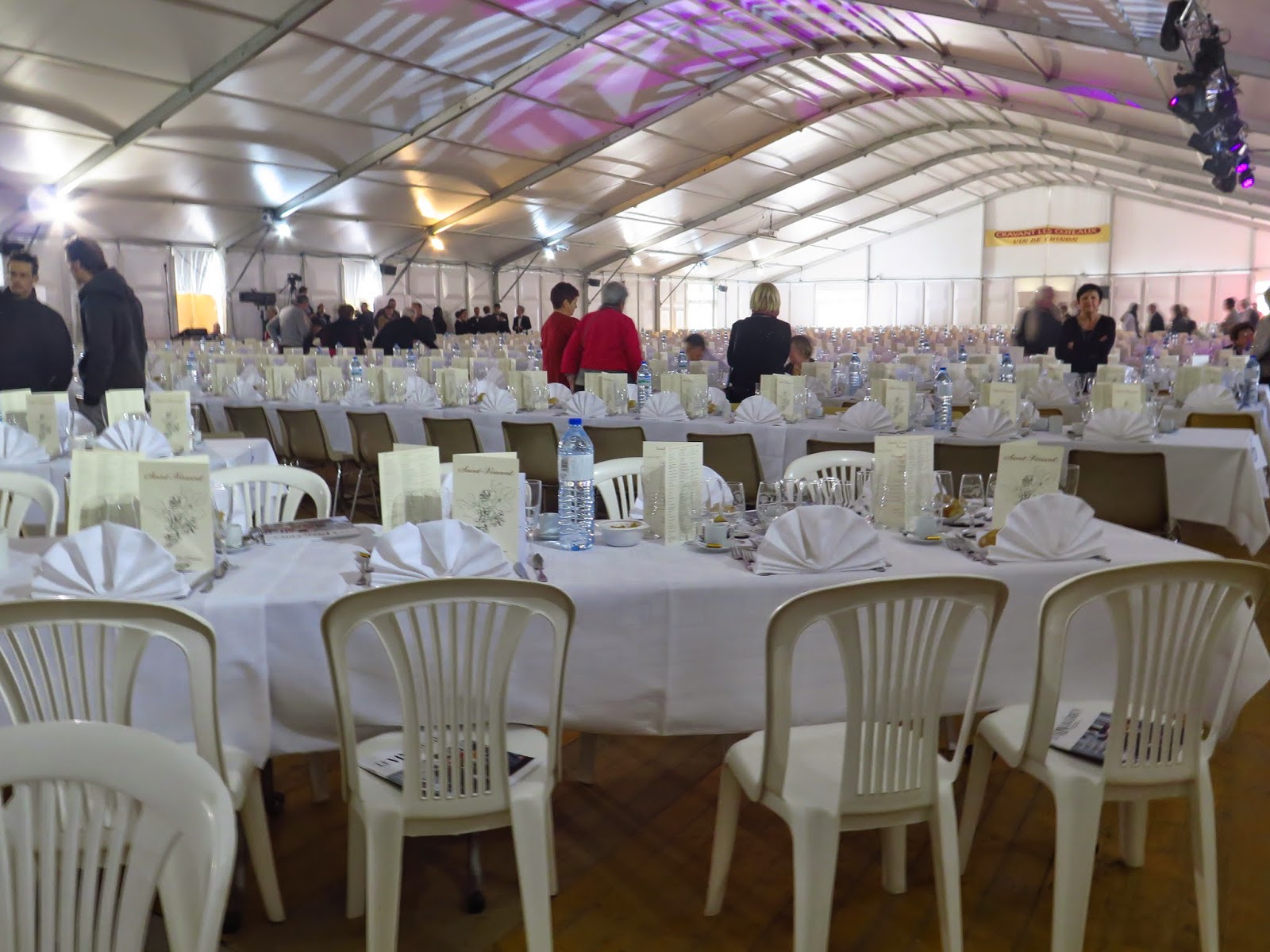
This year, Cravant achieved pole position in France, for the largest village party celebrating St Vincent-the patron Saint of wine-producers. It is an extraordinary achievement, resulting from years of consistently high-standards, hard work and determination.
Our introduction to St.Vincent took place in a large marquee which at the time was erected behind the salle de fête in the centre of the village. We didn't have our house then, but were staying with British friends who had a holiday home the other side of the village. Being Londoners with varying connections, we were used to large-scale catering and prestigious events, so the idea of St.Vincent was in our minds just another 'party'. We hadn't reckoned on being blown away by the quality, the efficiency, the professionalism and what we now know as being integral to this community's life, the conviviality.
That year there were 600 people. A wooden floor had been installed and heating as St.Vincent in Cravant, always on takes place on the last Saturday in January each year. The tables were laid up for silver service and looked fabulous. There was a stage area for announcements and presentations. I suppose then we were paying around €50 p.p. for an event that started at midday and finished in the early hours of the morning, and was inclusive of everything.
Fast forward to 2015. We're sitting in a huge marquee that sits 1600 quite comfortably, floor, heating, once again beautifully laid out. Alongside there is another marquee that houses the catering and serving teams which this year totals seventy people. Tickets were €84. We hadn't been sure if this number of people would work, but from our point of view, it was once again delicious.- a six course meal very well presented, with special wines, a tombola and entertainment. The meal finished around 8.30, then as per usual everyone left - for a wine tasting. Coaches had been laid on to transport people round the five wine producers. We walked to two nearby ones with neighbours and spent some time at Philippe Pion's Domaine des Quatre Vents. Makes lovely wine and there were lots of people there that we knew. So we pretty much stayed put. Eventually we wandered back to the marquee for some dancing. Think we got in around 2am.
Numbers of out of region visitors are increasing. We and our neighbours certainly weren't aware of that many locals. For Cravant it is now well established and has acquired a very good reputation. Apparently at least 200 people had to be turned away. Whether or not the numbers will be increased again, we don't as yet know. But there seems to be two trains of thought. One to keep it to 1600 and the other to go for 2000+. The problem with events like this is that the cost of them doesn't increase neatly across the event as a whole. There seem to be the same numbers of sponsors. Around 35. So there is a question as to what is going to happen next. Hopefully we'll discover more at the A.G.M.
I should add that St. Vincent at Île de Bouchard was brilliant and also the first time we'd been. There was a Mass to begin with, but afterwards everyone met at Panzoult in the huge cave which overlooks the village. It's an amazing place, which we visit at least once a year but always on May 1 for the annual Foire au vins. There were some prayers, speeches and an apéro or two, before we drove the short distance to the salle de fête in Île de Bouchard. We were with neighbours again and mutual friends. Probably about 400 people. Beautifully laid out. The same chef and team as at Cravant, although obviously smaller. Wonderful atmosphere. Lots of local people who were there to have a wonderful time. And we all did. Singing, dancing, sometimes on chairs and on the tables. Loved it.
Hopefully we'll go again next year.
Friday, January 30, 2015
My Musical Autobiography - so far
An idea that arrived from an American contact, who was asked to create her own, by the university professor who is leading a course about music therapy. An interesting idea.
Reading a UK report from last year which reported the idea that music services should be funded through Music Education Hubs rather than through local authorities and, that those Hubs have themselves received a funding reduction for 2014/15 of some 30%, I thought now was a good time to write my own musical autobiography. My musical life began at home, but was nourished through the Education System and maintained through my working life. Music is a deeply-rooted part of my life, so it is particularly pleasurable that certain of our younger friends are as deeply involved with music and are finding so much enjoyment.
Part One:
1. Started playing the piano aged I think 7.
2. Participated in a school musical entertainment.
3.Wrote my first play aged 10, which included music composition.
4. Listened to classical music with my father, who as a boy had
learnt to play the church organ.
5. Sang songs with the brownies each week.
6. Went to first ballet at Royal Festival Hall
Part Two:
1. Continued with the piano and started the clarinet.
2. Joined the school orchestra and the school choir.
3. Supply music teacher arrives and introduces us to Ramsey Lewis.
4. Finished piano exams
5. Joined local drama school and started entering music and drama festivals.
6. Joined the guides. Sang songs each week and during the summer camp.
7. Became aware of and then totally addicted to David Munro and early English music -
television series on Granada.
8 Riveted to Daniel Barenboim's Beethoven Sonata series on the BBC which if I remember correctly was on a Sunday morning.
9. Lost place in National Youth Theatre as very ill. Hospital for nearly a year.
10. Recovery. Changed school, new music, new everything.
Part Three:
1. Saw Canned Heat, Lindisfarne, Genesis and Van der Graaf Generator
2. Worked in independent music shop.
3. Went into Arts Centre Management as Arts Development Officer, programming music amongst other things.
4. Continued in Arts Management, but this time at The Arts Theatre/Unicorn Theatre for Children
5. Started learning to play the saxophone. Finished all the exams in three years.
6. Went to University. Joined a samba band, and a quartet.
7. Briefly part of the University choir.
8. Saxophones stolen while performing at Edinburgh Fringe Festival.
9. Going to concerts and gigs became the main outlet.
Part Four:
1. Started to play the accordeon and kazoo: everything and anything.
2. Currently co-organiser and singing in group (4 of us) covering pop classics French, British, American, Jazz, French chanson, Blues.
3. Gigging in France.
Reading a UK report from last year which reported the idea that music services should be funded through Music Education Hubs rather than through local authorities and, that those Hubs have themselves received a funding reduction for 2014/15 of some 30%, I thought now was a good time to write my own musical autobiography. My musical life began at home, but was nourished through the Education System and maintained through my working life. Music is a deeply-rooted part of my life, so it is particularly pleasurable that certain of our younger friends are as deeply involved with music and are finding so much enjoyment.
Part One:
1. Started playing the piano aged I think 7.
2. Participated in a school musical entertainment.
3.Wrote my first play aged 10, which included music composition.
4. Listened to classical music with my father, who as a boy had
learnt to play the church organ.
5. Sang songs with the brownies each week.
6. Went to first ballet at Royal Festival Hall
Part Two:
1. Continued with the piano and started the clarinet.
2. Joined the school orchestra and the school choir.
3. Supply music teacher arrives and introduces us to Ramsey Lewis.
4. Finished piano exams
5. Joined local drama school and started entering music and drama festivals.
6. Joined the guides. Sang songs each week and during the summer camp.
7. Became aware of and then totally addicted to David Munro and early English music -
television series on Granada.
8 Riveted to Daniel Barenboim's Beethoven Sonata series on the BBC which if I remember correctly was on a Sunday morning.
9. Lost place in National Youth Theatre as very ill. Hospital for nearly a year.
10. Recovery. Changed school, new music, new everything.
Part Three:
1. Saw Canned Heat, Lindisfarne, Genesis and Van der Graaf Generator
2. Worked in independent music shop.
3. Went into Arts Centre Management as Arts Development Officer, programming music amongst other things.
4. Continued in Arts Management, but this time at The Arts Theatre/Unicorn Theatre for Children
5. Started learning to play the saxophone. Finished all the exams in three years.
6. Went to University. Joined a samba band, and a quartet.
7. Briefly part of the University choir.
8. Saxophones stolen while performing at Edinburgh Fringe Festival.
9. Going to concerts and gigs became the main outlet.
Part Four:
1. Started to play the accordeon and kazoo: everything and anything.
2. Currently co-organiser and singing in group (4 of us) covering pop classics French, British, American, Jazz, French chanson, Blues.
3. Gigging in France.
Times have changed
I remember the first time we visited York in 1984. It was just before the Viking Centre opened, which we have since visited. At the time we were totally engrossed by York Castle Museum. On this first visit, to both my surprise and horror, I saw a virtual replica of my parents front room, from when I was about seven, and we were living in the East End of London. Strange feeling when your own life becomes a point of historical reference.
Felt the same on reading a posting of an article from the N.Y.Times, about "America's Worst Mom", who had been vilified for allowing her nine year old son to travel the metro alone. From the age of about eight until I was thirteen, when the family moved to Sussex, I used to make the journey quite regularly from Plaistow to the City, to visit my Uncle and Aunt for the weekend. It was a different world in the East End then. Of course it would be. Come the late fifties and early sixties we/London/the country were on the cusp of major change. I've never been back and probably never will, although a friend Gary who I discovered also lived there, has suggested we should.
At the time, my mother felt it safe enough to put me on a bus, with strict instructions not to talk to anyone, whilst the conductor was given strict instructions to keep an eye on me. In those days, such an arrangement was possible, even expected and always accepted. It was the same informal agreement that existed with the postman and the milkman. The likelihood then of someone being taken ill or dying and not being found for days or months wasn't feasible with such a network of regular contact - at least not where we were.
My journey was on the Greenline bus, which I think was an older version Routemaster, instead of the regular Red Routemaster. The route made very few stops so once you were on, your travelling companions pretty much remained the same, meaning less risk involved. Plaistow did have an underground but it wasn't possible to make the journey, without various changes on route. The bus allowed me to get off pretty much where I needed to be, with my aunt waiting for me at the stop. This of course wasn't the time of the mobile phone. I've no idea how long the bus ride took, but it was only once we'd got back to my aunt's house, that my mother would know I'd arrived safely the other end.
The Greenline still exists, although the cross London routes, of which mine was one, stopped in 1979. Increasing car use and faster parallel rail services meant passenger use rapidly declined. But between 1957 and 1960, when my family and I were using it, Greenline ridership was at its peak of 36 million passengers a year.
Felt the same on reading a posting of an article from the N.Y.Times, about "America's Worst Mom", who had been vilified for allowing her nine year old son to travel the metro alone. From the age of about eight until I was thirteen, when the family moved to Sussex, I used to make the journey quite regularly from Plaistow to the City, to visit my Uncle and Aunt for the weekend. It was a different world in the East End then. Of course it would be. Come the late fifties and early sixties we/London/the country were on the cusp of major change. I've never been back and probably never will, although a friend Gary who I discovered also lived there, has suggested we should.
At the time, my mother felt it safe enough to put me on a bus, with strict instructions not to talk to anyone, whilst the conductor was given strict instructions to keep an eye on me. In those days, such an arrangement was possible, even expected and always accepted. It was the same informal agreement that existed with the postman and the milkman. The likelihood then of someone being taken ill or dying and not being found for days or months wasn't feasible with such a network of regular contact - at least not where we were.
My journey was on the Greenline bus, which I think was an older version Routemaster, instead of the regular Red Routemaster. The route made very few stops so once you were on, your travelling companions pretty much remained the same, meaning less risk involved. Plaistow did have an underground but it wasn't possible to make the journey, without various changes on route. The bus allowed me to get off pretty much where I needed to be, with my aunt waiting for me at the stop. This of course wasn't the time of the mobile phone. I've no idea how long the bus ride took, but it was only once we'd got back to my aunt's house, that my mother would know I'd arrived safely the other end.
The Greenline still exists, although the cross London routes, of which mine was one, stopped in 1979. Increasing car use and faster parallel rail services meant passenger use rapidly declined. But between 1957 and 1960, when my family and I were using it, Greenline ridership was at its peak of 36 million passengers a year.
Tuesday, January 20, 2015
We have a new neighbour!
A very warm welcome to Anna Lassier, who came into the world on Sunday 18th January at 10h28, weighing in at just over 7lbs and just over 19 inches in length. Everyone is doing well. We have seen a photo of this gorgeous bundle on FB which her father Julien posted. Fast asleep and wrapped up warmly. So a family of three is now a family of four, and older sister Lily will before too long have another playmate. Félicitations!
Monday, January 19, 2015
Flexible and Creative
Essential factors for 18-30 years olds here in France, if they expect to have a future in the job market.
Been reading various articles to try a get an idea of the work market for young people. It's as challenging here as it is in the UK. What I've gleaned is as follows - it comes from various sources.
There was an enquiry at the beginning of 2014 concerning this age group, which numbers 21% of the workforce. Half of them seem to believe they will never have as good a life as their parents and about 30% believe they will never escape being in financial crisis. Statistics support these views.
22% of young people are still unemployed three months after having finished their studies. This % increases to 48% amongst the less qualified. There is a precariousness attached to any employment these days which functions on temporary or fixed-term contracts. Amongst these young people, the feeling of social injustice is well-established. Qualified or over-qualified, the reality for many is reliance on the minimum wage.
The family in France remains a huge source of emotional and material support, with the 40 or 50 year old parents themselves affected by the crisis and at times, periods of unemployment. The enquiry revealed that amongst the young, more than half receive financial aid from their parents, even when they are working. 36% of 18-30s are also still living with their parents at home - a situation which was made the subject of a film called Tanguy, which we watched on t.v. last year. Excellent film.
Although supportive, the parental generation can find itself at odds in the working world, with their own children, who reproach their parents for not making room for them. To some extent there has always been inter-generational tension in the job market. However whilst their professional lives are often difficult, the younger generation are actively pursuing other aspects of their lives that they want to achieve as citizens.
Personal fulfillment and community are very important. This younger generation is well informed, well connected and are, intuitively, IT whizzes. Being unable to integrate immediately into society, means they have had to find other ways to engage, which are frequently through community organisations.
Those who have found work often surprise business leaders in their attitude to it. Adaptability seems to be the key amongst today's 18-30s in terms of level of salary and job opportunity. In return they can be less attached and don't give a corporate career structure the same degree of importance as previous generations have done. There is a preference for acquiring a range of professional experience, rather than staying in one place. What counts above all else is the balance between the professional life and the private life.
In some respects this mirrors my own work experience when I first started in the late 60s. You gained experience by moving around. The difference being that then there was always something to move to, without the need to be overly motivated. Motivation and adaptability (amongst other things) have kept me employable my entire working life, including a number of career changes and being head-hunted. So there are aspects within current trends that I totally relate to.
Heaven help anybody though who doesn't 'fit the bill' and doesn't have the resources to help themselves.
Been reading various articles to try a get an idea of the work market for young people. It's as challenging here as it is in the UK. What I've gleaned is as follows - it comes from various sources.
There was an enquiry at the beginning of 2014 concerning this age group, which numbers 21% of the workforce. Half of them seem to believe they will never have as good a life as their parents and about 30% believe they will never escape being in financial crisis. Statistics support these views.
22% of young people are still unemployed three months after having finished their studies. This % increases to 48% amongst the less qualified. There is a precariousness attached to any employment these days which functions on temporary or fixed-term contracts. Amongst these young people, the feeling of social injustice is well-established. Qualified or over-qualified, the reality for many is reliance on the minimum wage.
The family in France remains a huge source of emotional and material support, with the 40 or 50 year old parents themselves affected by the crisis and at times, periods of unemployment. The enquiry revealed that amongst the young, more than half receive financial aid from their parents, even when they are working. 36% of 18-30s are also still living with their parents at home - a situation which was made the subject of a film called Tanguy, which we watched on t.v. last year. Excellent film.
Although supportive, the parental generation can find itself at odds in the working world, with their own children, who reproach their parents for not making room for them. To some extent there has always been inter-generational tension in the job market. However whilst their professional lives are often difficult, the younger generation are actively pursuing other aspects of their lives that they want to achieve as citizens.
Personal fulfillment and community are very important. This younger generation is well informed, well connected and are, intuitively, IT whizzes. Being unable to integrate immediately into society, means they have had to find other ways to engage, which are frequently through community organisations.
Those who have found work often surprise business leaders in their attitude to it. Adaptability seems to be the key amongst today's 18-30s in terms of level of salary and job opportunity. In return they can be less attached and don't give a corporate career structure the same degree of importance as previous generations have done. There is a preference for acquiring a range of professional experience, rather than staying in one place. What counts above all else is the balance between the professional life and the private life.
In some respects this mirrors my own work experience when I first started in the late 60s. You gained experience by moving around. The difference being that then there was always something to move to, without the need to be overly motivated. Motivation and adaptability (amongst other things) have kept me employable my entire working life, including a number of career changes and being head-hunted. So there are aspects within current trends that I totally relate to.
Heaven help anybody though who doesn't 'fit the bill' and doesn't have the resources to help themselves.
Thursday, January 15, 2015
Alternative Paris
Came across a really interesting initiative today which aims to rehabilitate people who are excluded or on the outer edges of society, back into work. Alternative Urbaine is an association coordinating a programme of guided walks led by someone who is homeless or unemployed.
The guides are paid by the association and enable visitors to discover a Paris that is authentic and unknown in the north-eastern districts of Belleville and Ménilmontant
(11th and 20th arrondissements).
Belleville and Ménilmontant were absorbed into Central Paris in the 1800s. The districts were initially used to house immigrants from rural France, then people from the former colonies of North Africa and Asia arrived. These days Belleville is home to a thriving artists' community and Chinese quarter. Ménilmontant has some of the buzziest venues in Paris, loads of nightlife and hip bars.
However there's more to be discovered. And part of the uniqueness of Alternative Urbaine project is the opportunity the guides offer to visitors, to meet and talk with Parisiens in places and spaces that are off the beaten track, but are important to the local area.
Generally organised at the weekend, each walk lasts between 1 and 2 hours. There isn't a charge. Instead each visitor pays a contribution directly to the guide.
There is a quotation on the site of Alternative Urbaine credited to Alexandra David-Néel, a Belgian-French explorer, Buddhist and writer, born in the mid 1800s, which eloquently expresses the concept at the heart of the project:
Someone who travels without meeting another isn't travelling, he's just moving.
www.alternative-urbaine.net
The guides are paid by the association and enable visitors to discover a Paris that is authentic and unknown in the north-eastern districts of Belleville and Ménilmontant
(11th and 20th arrondissements).
Belleville and Ménilmontant were absorbed into Central Paris in the 1800s. The districts were initially used to house immigrants from rural France, then people from the former colonies of North Africa and Asia arrived. These days Belleville is home to a thriving artists' community and Chinese quarter. Ménilmontant has some of the buzziest venues in Paris, loads of nightlife and hip bars.
However there's more to be discovered. And part of the uniqueness of Alternative Urbaine project is the opportunity the guides offer to visitors, to meet and talk with Parisiens in places and spaces that are off the beaten track, but are important to the local area.
Generally organised at the weekend, each walk lasts between 1 and 2 hours. There isn't a charge. Instead each visitor pays a contribution directly to the guide.
There is a quotation on the site of Alternative Urbaine credited to Alexandra David-Néel, a Belgian-French explorer, Buddhist and writer, born in the mid 1800s, which eloquently expresses the concept at the heart of the project:
Someone who travels without meeting another isn't travelling, he's just moving.
www.alternative-urbaine.net
Wednesday, January 14, 2015
Mr. Turner comes to Chinon
Couldn't be more appropriate really. Turner filled several sketchbooks with his impressions of famous Loire chateaux, such as Amboise, Saumur, Blois and Chambord, which supplied him with the perfect combination of hill, castle, town,bridge, river and people.
In 1826, when he was in his fifties and at the height of his powers, Turner spent two weeks travelling up the Loire from Nantes to Orléans. The results of his project were produced in his book Wanderings by the Loire, published in 1833, as part of a Rivers of France series.
Turner with his passion for sail, water, light and reflection, chose a good time to make the trip. Loire navigation was in the process of transformation. It appears he took the steamboat from Nantes to Angers - a new service - and then afterwards travelled by coach. so Turner was able to see the juxtaposition of steam and sail at close hand.
Clearly a very useful study source.
As to the film, well anything with Mr. Timothy Spall in it has a head-start as far as I'm concerned. The film was a really classy piece of work. Beautiful opening scenes of the Dutch landscape evoked Turner's colour palette. Came away with a real sense of person, place, the times. But strangely although engrossed by the film, I wasn't moved by it.
In 1826, when he was in his fifties and at the height of his powers, Turner spent two weeks travelling up the Loire from Nantes to Orléans. The results of his project were produced in his book Wanderings by the Loire, published in 1833, as part of a Rivers of France series.
Turner with his passion for sail, water, light and reflection, chose a good time to make the trip. Loire navigation was in the process of transformation. It appears he took the steamboat from Nantes to Angers - a new service - and then afterwards travelled by coach. so Turner was able to see the juxtaposition of steam and sail at close hand.
Clearly a very useful study source.
As to the film, well anything with Mr. Timothy Spall in it has a head-start as far as I'm concerned. The film was a really classy piece of work. Beautiful opening scenes of the Dutch landscape evoked Turner's colour palette. Came away with a real sense of person, place, the times. But strangely although engrossed by the film, I wasn't moved by it.
Friday, January 9, 2015
The beloved phone box . . .
Or at least it used to be. When was the last time I had to use a phone box. I actually can't remember. Probably from a railway station somewhere in the sixties, perhaps the seventies. But with the arrival of the mobile my allegiance changed.
Apparently there are still 65,000 red phone boxes in the UK and 8,000 in London. Seems the traditional reds have become synonymous with anti-social behaviour and are no longer a positive addition to public spaces. Hello to the trendy greens, otherwise known as the Solarbox, which by all accounts are reversing this trend, and are bringing a quintessentially piece of British design up to date. When we're in London this summer, we'll have to check one out for ourselves.
Here in France, the big telecommunications company, Orange, wants to finish with most of the phone booths by the end of 2015. Some will be kept going according to their strategic importance and daily usage levels, which must be more than three minutes per day. Phone booths positioned in hotels and stations will disappear by the end of December 2016.
While waiting for the changes to be introduced, the French have found another use for the booths. Some have been transformed into mini libraries, with people depositing and taking books freely. Phones and books, two great forms of communication, side by side.
Apparently there are still 65,000 red phone boxes in the UK and 8,000 in London. Seems the traditional reds have become synonymous with anti-social behaviour and are no longer a positive addition to public spaces. Hello to the trendy greens, otherwise known as the Solarbox, which by all accounts are reversing this trend, and are bringing a quintessentially piece of British design up to date. When we're in London this summer, we'll have to check one out for ourselves.
Here in France, the big telecommunications company, Orange, wants to finish with most of the phone booths by the end of 2015. Some will be kept going according to their strategic importance and daily usage levels, which must be more than three minutes per day. Phone booths positioned in hotels and stations will disappear by the end of December 2016.
While waiting for the changes to be introduced, the French have found another use for the booths. Some have been transformed into mini libraries, with people depositing and taking books freely. Phones and books, two great forms of communication, side by side.
We raised our pencils yesterday!
Thursday 8 January 2015. A large crowd gathered in Chinon yesterday outside the town hall for a minute's silence to mark the events of the last few days in Paris. Some held placards, some wore badges, some raised pencils. Then we drifted away as quietly as we had arrived.
A moment of great emotion and solidarity.
A moment of great emotion and solidarity.
Wednesday, January 7, 2015
For chocolate fans both sides of the channel!

Thought I was going to be writing a little snippet about a 120th anniversary that is being celebrated this year, in France. But on delving a little further, found a bigger story that crossed the channel.
The village of Chambéry is the home of the chocolate truffle. Le pâtissier Louis Dufour created the now world-renowned Savoyarde speciality, at the end of the 19th century. The chocolate truffle's arrival was purely by chance when, during a competition Louis Dufour discovered he didn't have enough cocoa. He added crème fraîche, some vanilla to the mix and then rolled the little balls in powdered chocolate. Et voilà, the chocolate truffle was born.
In 1902 Antoine Dufour came to England, opening the first Prestat shop in South Molton Street, London. Another two were opened in Oxford Street and in the City of London. The business was passed to Antoine's son, Tony Dufour, who ran it into the 1950s. Trading difficulties emerging from WW2, saw the company sold on. The company received royal warrants in 1975 to Queen Elizabeth ll and Queen Elizabeth the Queen Mother in 1999. The current flagship store is in Piccadilly. In 2009 Prestat opened in Harrod's Chocolate Hall.
Prestate has been owned by brothers Nick Crean and William Keeling since1998.
There wasn't much of the history to be found in terms of documents and packaging. However the two shop managers Peggy Cramer and Dilys Wilson, who combined, have worked for the company for over seventy years, were able to fill in some gaps and supply some information. The brothers have Antoine Dufour's original recipes for chocolate caramels, coffee caramels, chocolate fudge, Turkish Delight, violet fondant, rose fondant and of course, chocolate truffels.
So London friends, if you haven't already - go check them out, and have one for me!
Monday, January 5, 2015
On the road and back to France
 |
| Bridge at BOA |
Our final morning having got packed-up, met some of the girls for coffee at the Fat Fowl, where we'd virtually taken up residence since we arrived, with all the coffees, lunches and diners. Good to see owners Arlene and Mark again. We'd had a superb dinner there with friends the night before. Saturday morning as we left, the place was buzzing. Mike had moved the car up to the top of town, before picking me up on the way for a final visit to see our long-time friend John Salvat. Had a light bite there with him before heading off to Shoreham to stay overnight with more long-time friends, June and John, who we hadn't seen for about two years.
 |
| Harbour at Shoreham |
Eventually we had to leave for Portsmouth and the ferry home. A reasonable number of vehicles on board. No lorries though. Set sail on time at 22.45pm and arrived in France on time at 6.45 am (French time). Time on board is always British and there's an hour's difference. We were up at 4.30 British time., breakfast at 5 and off the boat by 6am or 7am French time. Driving in the dark for about an hour before dawn began to break. Good journey with a stop, and back in through our front door by 10.30am, feeling slightly weary. But a cup of coffee soon sorted that out.
A really good visit. Useful as well as good fun. Thanks and much love everyone - you know who you are.
Subscribe to:
Posts (Atom)