It started Friday night with a lovely dinner with local friends Nadia and Patrick. Continued yesterday evening, with a Christmas party last night in Chinon, where we entertained each other with songs, poems, stories, games and a wine tasting. Everyone brought something for the table as well, which was all very delicious and very festive. Then at the end of the evening we had a Secret Santa. A good evening.
Today we were over at Philippe and Clothilde Pain's (father and daughter) Domaine de la Commanderie, with our neighbours Jacqueline et Norbert, for the first of the Christmas porte-ouvertes. These are the same vignerons where Mike and I went to help briefly with the vendange in October. Family and long-time helpers were out in force for what was - I think - a four-day affair.Huge amount of work and pre-preparation goes into these events. They are so well done, with a great atmosphere. We'd booked to have lunch there as well. Philippe was busy barbecuing the beef for the main dish or a special veal dish was the alternative. Home made terrine as starter, main dish, cheese and tarte au vigneron for dessert/€15p.p. The cave at Domaine de la Commanderie is just brilliant for this sort of thing. It's a good sized space, so it's easy to move around, with plenty of room for other producers and artisans. There were some white wine producers this year. The link is to Clothilde's FB page. It has some great photos from the event and gives you a good idea. Came away with just a few bottles of wine. Quel surprise!! There were also some photos from the vendange on display, including the one of Mike, which I love and he now uses as his FB photo.
Tales from Cravant

A Cravant View
Sunday, December 7, 2014


Friday, December 5, 2014
What a brilliant idea!
I meant to write this up for a blog before. Earlier this year the French parliament passed a law which enables workers, with the agreement of their employer, to anonymously donate their paid leave to colleagues, with seriously ill children.
The inspiration for the bill came from the case of Christophe Germain who, with the approval of the bosses, was given days off by his colleagues (170) to look after his eleven year old son, Matthys, who was battling with cancer. Very sadly Matthys died. The scheme which was present in some private companies was then extended to the public sector. There was some resistance to the changes, as it was thought they relieved employers of their responsibilities towards staff with seriously ill children. However in May 2014 the idea became legal.
Only last month another case hit the headlines. This time concerning a very sick wife, who was about to give birth on 17th November, but who had been hospitalised since July 2014 after a brain haemorrhage. The colleagues of the husband decided to donate time so that he could remain at home to look after his wife. Her condition was such that she would need round-the-clock supervision and would have to learn how to walk again. In total 362 paid days were donated, by individuals across the company including the managers.
That's solidarity for you. Any chance of it happening in the UK?
The inspiration for the bill came from the case of Christophe Germain who, with the approval of the bosses, was given days off by his colleagues (170) to look after his eleven year old son, Matthys, who was battling with cancer. Very sadly Matthys died. The scheme which was present in some private companies was then extended to the public sector. There was some resistance to the changes, as it was thought they relieved employers of their responsibilities towards staff with seriously ill children. However in May 2014 the idea became legal.
Only last month another case hit the headlines. This time concerning a very sick wife, who was about to give birth on 17th November, but who had been hospitalised since July 2014 after a brain haemorrhage. The colleagues of the husband decided to donate time so that he could remain at home to look after his wife. Her condition was such that she would need round-the-clock supervision and would have to learn how to walk again. In total 362 paid days were donated, by individuals across the company including the managers.
That's solidarity for you. Any chance of it happening in the UK?
Wednesday, November 26, 2014
A delicious story - part 2
Mastering temperature was the great advance in the twentieth century, along with the understanding of the chemical and biological elements contained within certain products. New flavours and textures were developed.
 Gaston Lenôtre was extraordinarily innovative and the man of the century with regards to pâtisserie. He also created the first chain of upscale bakeries in Paris, a bakery-café bistro in the first French shopping mall, the first professional French re-training chef school, the first line
of frozen desserts distributed all over France, and the first
International bakery franchises - now in a dozen countries. He wrote nine recipe books and catered for Olympic teams,Kings, Presidents and celebraties all over the world. And was one of the main inspirations for the character Gusteau in the film Ratatouille. He died in 2009.
Gaston Lenôtre was extraordinarily innovative and the man of the century with regards to pâtisserie. He also created the first chain of upscale bakeries in Paris, a bakery-café bistro in the first French shopping mall, the first professional French re-training chef school, the first line
of frozen desserts distributed all over France, and the first
International bakery franchises - now in a dozen countries. He wrote nine recipe books and catered for Olympic teams,Kings, Presidents and celebraties all over the world. And was one of the main inspirations for the character Gusteau in the film Ratatouille. He died in 2009.
These days it is the likes of Pierre Hermé, Philippe Andrieu, Christophe Michalak and Christophe Adam, who lead the way, revisiting classic French pâtisserie and extending the flavours and textures well beyond France's borders - the Paul chain of boulangeries being an example, for which both Pierre Hermé and Philippe Andrieu have worked. Paul was founded in 1889 and now belongs to the Holder Group, which also owns the luxury bakery Ladurée. I used to visit a Paul in Convent Garden, when I was working in the theatre. These days Paul have extended into motorway services, so we time our stops to take advantage of their delicious pâtisserie, salads or sandwiches.
A few classics and their stories: Le Saint-Honoré is typical of the 19th century in being named after a Saint. In this instance the Patron Saint of boulangers. It was created in 1850 by Chilboust a famous parisien pâtissier who had set up in rue Saint Honoré. Some of the best Saint-Honoré are made by Dalloyau in Paris, who is also responsible for L'Opéra, which was created in 1955. It takes its name from a prima ballerina and some young ballet students who would go there for tea and to taste the delicious cakes and pastries.
 Le Paris-Brest was created by Louis Durand in 1910 in hommage to the Paris-Brest-Paris cycle race, which began in 1891 and was last run in 1951. The round shape was meant to represent a bicycle wheel. Choux pastry and praline cream.
 Le Financier was created in the Middle Ages in an oval shape by the sisters of the Order of the Visitation. It wasn't particularly appreciated until the late 1800s when the pâtissier Lasne brought the little cake 'up-to-date'. Being based near to the Paris Stock Exchange and as his clientele were primarily money-men, Lasne had the idea of renaming the cake Le Financier and reshaping it into a rectangle, representing a gold ingot.
All these amazing ideas and technical skill, and here I am just coming to grips with the method for omelette making, using an electric hob as opposed to gas, which I'd been cooking with for years. It's electricity for us now both sides of the Channel. Ah well!!!
These days it is the likes of Pierre Hermé, Philippe Andrieu, Christophe Michalak and Christophe Adam, who lead the way, revisiting classic French pâtisserie and extending the flavours and textures well beyond France's borders - the Paul chain of boulangeries being an example, for which both Pierre Hermé and Philippe Andrieu have worked. Paul was founded in 1889 and now belongs to the Holder Group, which also owns the luxury bakery Ladurée. I used to visit a Paul in Convent Garden, when I was working in the theatre. These days Paul have extended into motorway services, so we time our stops to take advantage of their delicious pâtisserie, salads or sandwiches.
A few classics and their stories: Le Saint-Honoré is typical of the 19th century in being named after a Saint. In this instance the Patron Saint of boulangers. It was created in 1850 by Chilboust a famous parisien pâtissier who had set up in rue Saint Honoré. Some of the best Saint-Honoré are made by Dalloyau in Paris, who is also responsible for L'Opéra, which was created in 1955. It takes its name from a prima ballerina and some young ballet students who would go there for tea and to taste the delicious cakes and pastries.
All these amazing ideas and technical skill, and here I am just coming to grips with the method for omelette making, using an electric hob as opposed to gas, which I'd been cooking with for years. It's electricity for us now both sides of the Channel. Ah well!!!
Tuesday, November 25, 2014
A delicious story - part 1
 |
| oublie |
Over the next couple of centuries, tarts using milk, eggs and cream were developed. By the 1500s beautiful pâtisseries were very much part of the French court's culinary scene. Catherine de Médicis married Henry ll in 1533 and brought her chefs and confectioners to France. The French court was then introduced to ice cream, madeleines (sponge cakes), les biscuits à la cuiller/sponge fingers and choux pastry, invented in 1540 by the Italian pâtissier Popelini, who came to France to join the Médicis entourage.

establishing the first of the really great chefs and pâtissiers in their own right. Amongst them were François Pierre de La Varenne who created the millefeuille and François Vatel who is credited with the creation of Chantilly Cream.
 |
| petits-fours |
After the revolution, many cooks found themselves without their master chefs who had fallen victim to events, either by being beheaded or exiled to England. So they opened their own restaurants and as a result there was an explosion of culinary creation. In 1806 in response to the European blocade imposed by Napoleon, the British navy prohibited the importing of sugar to France, from the Caribbean. The need to find an alternative lead to the discovery of sugar beet, and ultimately the development of patisserie that we recognise and so appreciate today.
 |
| savarin |
The 19th century saw the development of the biscuit business, but also the technical advances which introduced the whisk, pastry bag and egg beaters and enabled the pâtissiers as craftsmen to become established. This century belongs particularly to Antonin Carême, a chef and pâtissier of extraordinary renown, whose clientele were amongst the highest at home and abroad. His book, Le Pâtissier Royal Parisien, is still used as reference today supplying for the first time, the exact details and quantities of the ingredients. There were others of course at this time who were also producing delicious concoctions. The brothers Julien and the savarin - a baba without dried raisins. The Vacherin, saint-honoré, profiteroles, éclairs, fondant, the Yule log all date from this period. It was clearly a prolific time.
Monday, November 17, 2014
70 somethings, other Iconic Figures and newsy bits

Came across a couple of snippets of information last week. Both concern the writing world although from vastly different directions.
Le Monde started up in 1944. One of the most well-known daily newspapers, it celebrates its 70th anniversary this year. A mere teenager compared to some, but nonetheless grasping all that modern technology has to offer. Here's me, the new owner of a mini ipad. How long has it taken me to round to buying one!! Then there's Le Petit Prince -an iconic piece of French literature. Just love it. This 70th anniversary marks the disappearance of the author/pilot Antoine de Saint-Exupéry.
Sir Quentin Blake received France's highest accolade this year - the Chevalier of the Légion d'honneur. Hadn't realised that he was such a francophile or that he has had a home in La Rochelle for at least twenty years. He is bi-lingual with a profound appreciation of French culture. A wonderful illustrator who is clearly greatly appreciated both sides of the channel.
Closer to home, we've had projects popping out from every corner. Busy coordinating a WWl evening for one of the bi-lingual groups we belong to at the end of November and a Christmas party the week after, for another. A new association is being set up in Chinon, which focuses on the Renaissance period. The Collectif Carnaval Re-Naissance Chinon had it's inaugural meeting a week ago. The project has been master-minded by Valérie Poignonec. Obviously it's in the very early stages of development, but a committee has been formed, a team of enthusiastic and experienced individuals who can design and sew is coming together. But more people are needed as well as materials with which to design and make authentic costumes. Mike and I have been working on the publicity and yesterday presented the logo, poster and leaflet to the group which went down extremely well.
Another thing we're really looking forward to starts this Friday, when we have our first session of helping with English pronunciation at a local primary school in Chinon. It's on a voluntary basis. We each help in two consecutive classes, which are about twenty minutes long. Mike has the older school children, as they are closer to his height and I have the younger age group - as they are closer to mine!! It's a regular weekly commitment of 40 minutes. We met the Head Teacher a week or so ago whose idea this was. Seems a really nice man and very enthusiastic. So keep your fingers crossed!!
Sunday, November 2, 2014
Travels in the Midi-Pyrénées
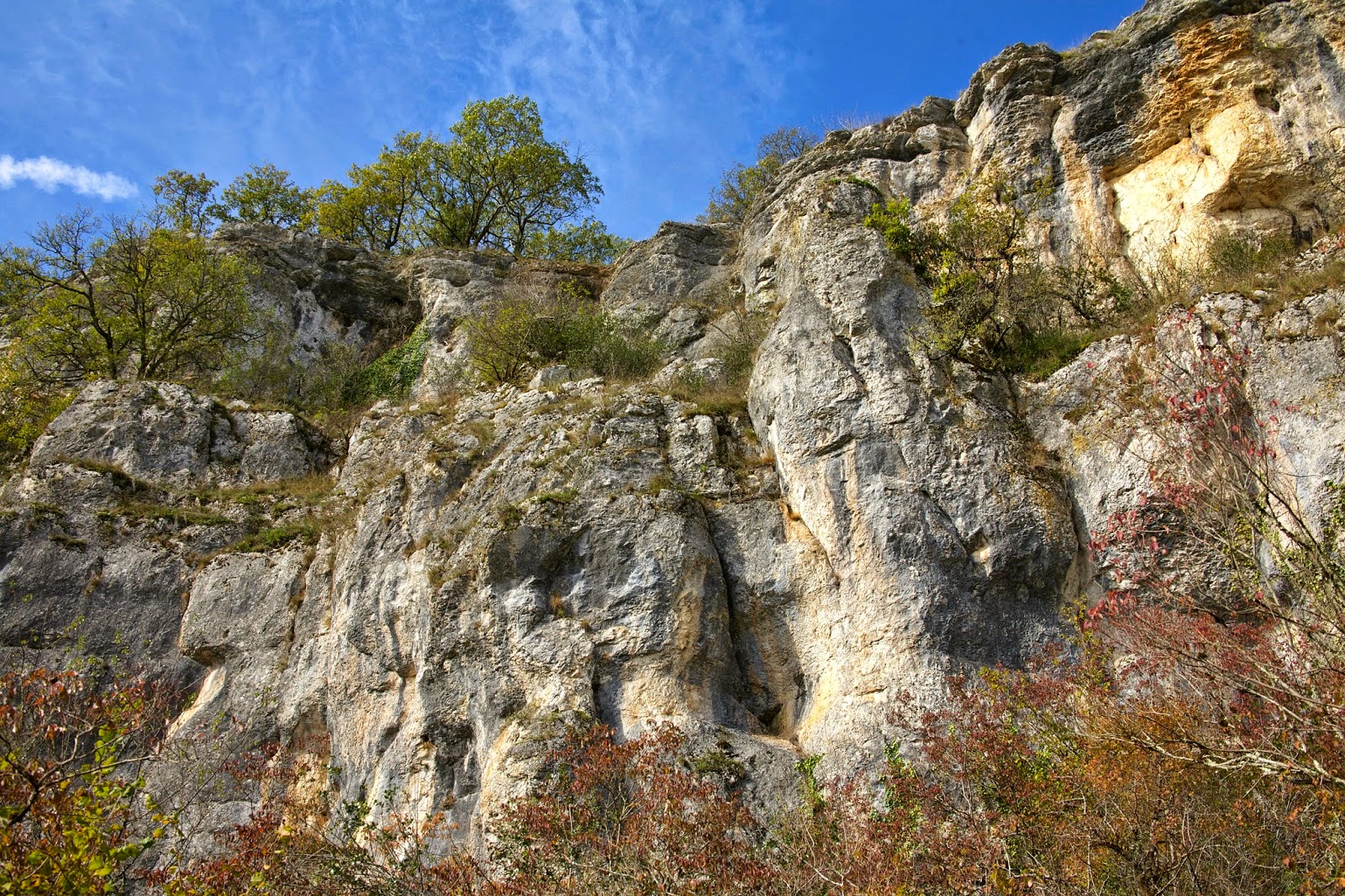


As for food and wine of the region, everything we had was excellent, Fi's cooking, dinner at Le Petit Relais (which is at the top of the 2k track that leads to the Moulin de LaTreille) and Les Vieilles Tours, about a twenty minute drive away. Both are hotel restaurants, but with very different styles. It was also interesting for us to taste a different wine grape from the Cabernet Franc that is used here in the Chinon Appellation. We were of course in the great region of Cahors. So delicious wines were not hard to find.
Hopefully we can go back next year. Late October is a good time to go. There are places nearby which we didn't get to. So plenty to explore. May be we can work out a two-centre break. All sorts of possibilities. Anyway we had a great time. And if anyone fancies a visit to the Lot and wants a recommendation for somewhere to stay, try Moulin de LaTreille.
Monday, October 27, 2014
Busy time
What with meeting friends for lunch, rehearsals, a concert, having friends round for lunch, apèros, a Spanish lunch, wedding anniversary, ukulele lessons and other stuff, it has been a very busy time. Fortunately a short holiday in the Lot beckons, so we can re-charge in time for Hallowe'en. A road party is planned!
Our gig last Friday went really well. It's always a mixture of French and English songs, in different combinations of voices, different styles of song as well. There was a real challenge this time with a song called Quant on n'a que l'amour, a duet which I sang with and a French friend Christine. It's very popular in France, but also a big song to sing as it needs to be sung out and gradually builds up to a powerful finish which has to be held. Pleased to report we nailed it. I'm a mezzo-soprano and Christine is a soprano and we've steadily discovered that our voices are just great together. We always sing a couple of songs as duets, but we both want to do more and have got some fab songs lined up for the next gig. Mike and a French friend Patrick provide most of the musical accompaniment, but also sing. They have concentrated so far on songs by George Brassens, which are stunning pieces, immensely difficult to do, but they always manage to sing them well. The fact that they enjoy playing the songs and together, makes a huge difference. Others are involved at various points throughout the evening. This time eight people in all played or sang something. Very satisfying and a great atmosphere.
Our gig last Friday went really well. It's always a mixture of French and English songs, in different combinations of voices, different styles of song as well. There was a real challenge this time with a song called Quant on n'a que l'amour, a duet which I sang with and a French friend Christine. It's very popular in France, but also a big song to sing as it needs to be sung out and gradually builds up to a powerful finish which has to be held. Pleased to report we nailed it. I'm a mezzo-soprano and Christine is a soprano and we've steadily discovered that our voices are just great together. We always sing a couple of songs as duets, but we both want to do more and have got some fab songs lined up for the next gig. Mike and a French friend Patrick provide most of the musical accompaniment, but also sing. They have concentrated so far on songs by George Brassens, which are stunning pieces, immensely difficult to do, but they always manage to sing them well. The fact that they enjoy playing the songs and together, makes a huge difference. Others are involved at various points throughout the evening. This time eight people in all played or sang something. Very satisfying and a great atmosphere.
Subscribe to:
Posts (Atom)